
Introduction
If you manage residential or commercial builds in NC, TN, SC, or VA, the question comes up on every project: how long is the poured concrete foundation timeline going to take? It’s one of the most important scheduling questions in construction because the poured concrete foundation timeline determines when your framing crew mobilizes, when mechanical rough-in begins, and ultimately when you can deliver. Get the foundation installation schedule wrong and every downstream trade pays for it.
The honest answer is that the poured concrete foundation timeline depends on several overlapping variables — site conditions, weather, foundation complexity, permit status, and crew coordination. But there’s a reliable phase structure that governs nearly every residential and light commercial project, and understanding it puts you in control of your master schedule rather than reacting to delays after they happen.
This guide walks through the complete poured concrete foundation timeline phase by phase, with the scheduling detail that builders and general contractors actually need. For context on how the poured concrete foundation timeline compares to block construction, see our poured concrete vs. block foundations guide. For code requirements that affect foundation depth and design in your area, see our regional foundation building codes guide for NC, TN, SC, and VA.
Why the Poured Concrete Foundation Timeline Matters More Than You Think
In a volume building environment, the poured concrete foundation timeline isn’t just a scheduling box to check — it’s a competitive variable. A builder who consistently gets foundations in and cured in 10 days moves more starts per season than one whose foundation installation schedule routinely runs 16 or 18 days. That difference compounds across a full production calendar into a meaningful revenue gap.
The poured concrete foundation timeline is also the phase most vulnerable to weather, inspection delays, and subcontractor coordination gaps. Building accurate schedule buffers requires understanding what can and can’t be compressed in each phase — and where the genuine schedule risk actually lives.
Phase 1: Site Preparation and Excavation
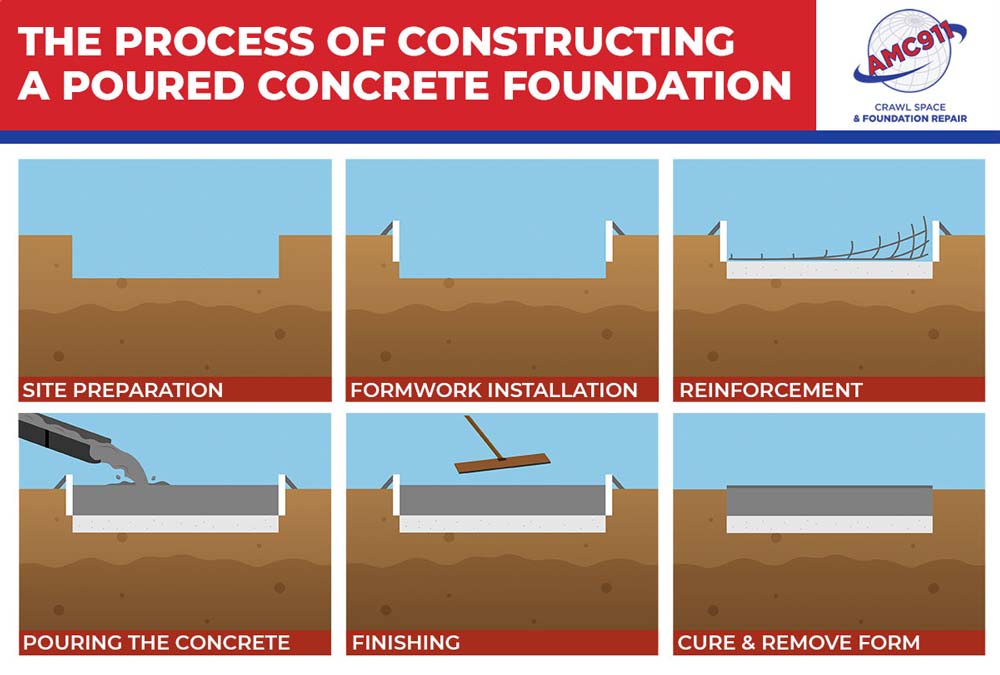
No poured concrete foundation timeline begins until the site is ready. Site preparation includes clearing, excavation to the required depth, rough grading, and compaction of the bearing surface. In NC, TN, SC, and VA, excavation depth is driven by the frost line, structural engineer specifications, and local code requirements — typically ranging from 12 inches in the lower Piedmont to 24 inches or more in the Appalachian mountain counties of western NC, east TN, and southwest VA.
Soil conditions are the primary variable in this phase of the poured concrete foundation timeline. Sandy loam excavates fast and cleanly. Heavy clay soils — prevalent across the Piedmont — take longer and often require additional grading passes. Rocky substrate adds cost and time regardless of equipment size. Review OSHA excavation safety requirements before breaking ground — proper shoring and slope requirements affect both safety and schedule on any foundation installation.
Critical scheduling note: never mobilize the excavator until footing dimensions and elevations are confirmed with your foundation contractor. Redigging to correct depth or width is one of the most common and avoidable poured concrete foundation timeline setbacks.
Phase 1 of the poured concrete foundation timeline: 1–3 days. Rocky or clay-heavy sites push toward the top of that range. Confirm footing specs before excavation starts to avoid rework.
Phase 2: Footing Installation and Cure
Footings are the first concrete poured in the poured concrete foundation timeline. They distribute the load of the foundation wall across a wider bearing area and are sized by a structural engineer based on soil bearing capacity, building loads, and applicable code tables. Per the applicable IRC code tables, footing width and thickness are prescribed based on the number of stories and foundation wall configuration.
Footing forming and pouring is typically a one-day operation. The rate-limiting factor in this phase of the poured concrete foundation timeline is cure time. Footings must reach adequate compressive strength before forms are set on top — typically 24 to 48 hours under ideal conditions (above 50°F, no precipitation). The Portland Cement Association recommends concrete not be placed in temperatures below 40°F without protective measures, and the poured concrete foundation timeline must account for extended cure windows during cold-weather work in mountain zone projects.
In winter months across NC, TN, and VA mountain counties, footing cure time can stretch to 72 hours or more without heated enclosures or concrete blankets — adding a full day to this phase of the poured concrete foundation timeline. Build that buffer into any project scheduled between October and March.
Phase 2 of the poured concrete foundation timeline: 2–4 days including cure. Cold weather is the primary risk. Never set wall forms on green footings — settlement and cracking follow.
Phase 3: Form Setting and Rebar Placement
Once footings are cured, form setting begins. Poured concrete foundation forms — typically steel or aluminum panel systems — are erected, plumbed, braced, and tied to engineered specifications. This phase of the poured concrete foundation timeline also includes installation of window bucks, door openings, utility sleeves, and any beam pockets that need to be cast in place during the pour.
Rebar placement happens during form setting as well. Horizontal and vertical reinforcement is tied and positioned per the structural drawings, with proper cover maintained from the form face. This is not a phase to compress in the poured concrete foundation timeline — under-reinforced foundations are one of the most common causes of structural warranty claims on residential construction.
For a standard residential foundation, form setting and rebar placement takes one full crew day. L-shaped foundations, step-down configurations, walkout basements, and foundations with significant penetrations take longer — plan accordingly in your poured concrete foundation timeline.
Phase 3 of the poured concrete foundation timeline: 1 day standard, 1.5–2 days for complex geometry. Don’t rush rebar placement — it’s not recoverable after the pour.
Phase 4: Concrete Pour
The pour is the centerpiece of the poured concrete foundation timeline. For most residential poured concrete foundations, the pour itself runs four to eight hours including setup, pump positioning, vibration, and finishing the top of the wall. Concrete arrives by ready-mix truck and is typically pumped into the forms via boom pump.
Mix design is critical to poured concrete foundation performance. The IRC minimum for foundations in severe weathering regions — which includes the mountain zones of NC, TN, and VA — is 3,500 PSI with air entrainment. Most quality builders and structural engineers specify 4,000 PSI. Low water-cement ratio concrete is essential in freeze-thaw environments to prevent long-term surface degradation.
Weather is the single largest variable in the poured concrete foundation timeline at this phase. Rain during an active pour introduces water to the mix and compromises the surface. Temperatures above 90°F accelerate set time and require retarders. Temperatures below 40°F require insulated forms, concrete blankets, or heated enclosures. At Echo Concrete, we monitor weather windows and will delay a pour rather than compromise it — trying to pour in marginal conditions to protect a schedule creates more timeline risk than a one-day delay ever would.
Phase 4 of the poured concrete foundation timeline: 1 day. Weather is the main variable. Pour in a 50–80°F window with no precipitation forecast. Don’t let schedule pressure push a pour into bad conditions.
Phase 5: Curing and Form Strip
Curing begins the moment the pour is complete. Concrete curing is a chemical process — the hydration of Portland cement — not simply drying. Concrete reaches approximately 50% of its design strength within 24 to 48 hours, 70% within seven days, and continues gaining strength for 28 days. The poured concrete foundation timeline for form stripping is typically 24–48 hours after the pour under normal conditions.
In cold weather, stripping should be delayed until the concrete has achieved sufficient strength — often 48–72 hours or more. Stripping too early in pursuit of a compressed poured concrete foundation timeline risks surface damage, spalling, and in cold conditions, freeze damage to the wall face. If schedule pressure is intense, a set-accelerating admixture can be added to the mix design to reduce the cure window — but it must be specified before the pour, not added on-site.
Phase 5 of the poured concrete foundation timeline: 1–3 days. Don’t strip early to reclaim schedule. The curing window is the one phase of the foundation installation schedule that cannot be safely compressed without proper admixtures.
Phase 6: Waterproofing and Drainage Installation
Waterproofing and drainage installation follows form stripping in the poured concrete foundation timeline. A poured concrete foundation wall’s smooth, monolithic surface accepts waterproofing membranes more readily and consistently than block walls — one of the concrete wall advantages that compounds over the building’s lifetime. See our full guide to poured concrete vs. block foundations for a detailed breakdown of why this matters for long-term building performance.
Perimeter footing drains are installed at this phase, sloped to daylight or a sump collection point. Drainage system routing needs to be coordinated with your excavation contractor before backfill. This is a one-day phase in the poured concrete foundation timeline under normal conditions, but coordination timing between trades can create a gap if drainage routing isn’t confirmed before the pour date.
Phase 6 of the poured concrete foundation timeline: 1 day. Coordinate drainage routing with your excavation contractor before pour day to avoid trade gaps after form strip.
Phase 7: Backfill
Backfill is the final phase of the poured concrete foundation timeline. Best practice is to delay backfill until first-floor framing is installed, which braces the top of the foundation wall before soil pressure is applied. Backfilling an unbraced wall on deep excavations — particularly on hillside lots or in areas with clay soils — risks inward deflection that can compromise the entire poured concrete foundation.
Once backfill is complete, the poured concrete foundation timeline is closed and framing can begin. Coordinate your framing crew mobilization for the day following backfill completion — don’t schedule them to arrive before the poured concrete foundation timeline is confirmed closed.
Full Poured Concrete Foundation Timeline Summary
Total poured concrete foundation timeline: 7–14 days under normal conditions. Mountain zone projects in cold weather or projects with complex geometry can extend to 16–18 days. Budget 14 days as your standard master schedule placeholder for the foundation phase and flag the pour date as weather-contingent.
Echo Concrete provides project-specific poured concrete foundation timelines to builders and GCs across NC, TN, SC, and VA. Submit your blueprints at echowalls.com and we’ll give you an accurate mobilization date for your foundation installation schedule.