
Introduction
Site preparation for a poured concrete foundation is where most foundation problems start — not at the pour, not during curing, but in the days before the first concrete truck rolls onto the job. Poor site preparation for poured concrete foundations leads to footing failures, drainage problems, cracked walls, and inspection holds that blow schedules and budgets in ways that are expensive and nearly impossible to fix after the fact.
Most builder guides treat site preparation for poured concrete foundations as a checklist item to get through before the real work begins. That’s backwards. Site preparation for poured concrete foundations is the work — it’s the phase where you establish the conditions that determine whether every subsequent phase of the poured concrete foundation timeline goes cleanly or creates problems you’ll be managing for years.
This guide covers site preparation for poured concrete foundations the way builders and GCs operating in NC, TN, SC, and VA need it — from excavation standards and soil assessment to drainage planning and pre-pour inspection. For how site preparation fits into the full poured concrete foundation timeline, see our foundation installation schedule guide. For the code requirements that affect site preparation depth and drainage, see our foundation building codes guide for NC, TN, SC, and VA.
Why Site Preparation for Poured Concrete Foundations Matters More Than Most Builders Realize
The poured concrete foundation is only as good as what it’s sitting on. A monolithic poured concrete wall with perfect reinforcement, ideal PSI mix, and proper waterproofing will still fail if the bearing surface wasn’t properly prepared, the drainage wasn’t designed to move water away from the structure, or the excavation wasn’t cut to the right dimensions and elevation.
Site preparation for poured concrete foundations is also the phase most directly controlled by the builder and GC — more so than weather, concrete delivery timing, or inspection scheduling. Investing the time to get site preparation for poured concrete foundations right is the highest-return activity on the pre-pour checklist.
Step 1: Site Assessment and Soil Evaluation
Site preparation for a poured concrete foundation begins with understanding what you’re building on. Soil bearing capacity — the ability of the soil to support the structural load — determines footing size, foundation depth, and in some cases, whether the prescriptive IRC footing tables even apply or whether engineered drawings are required.
For most residential projects, a visual assessment and probe by an experienced foundation contractor is sufficient to identify obvious problem conditions: organic fill, loose or disturbed soil, high water table signs (standing water, saturated subsoil), or expansive clay that shrinks and swells with moisture changes. On larger or higher-risk projects, a formal geotechnical report is warranted. The Portland Cement Association publishes guidance on soil classification and bearing capacity assessment that provides a useful reference framework.
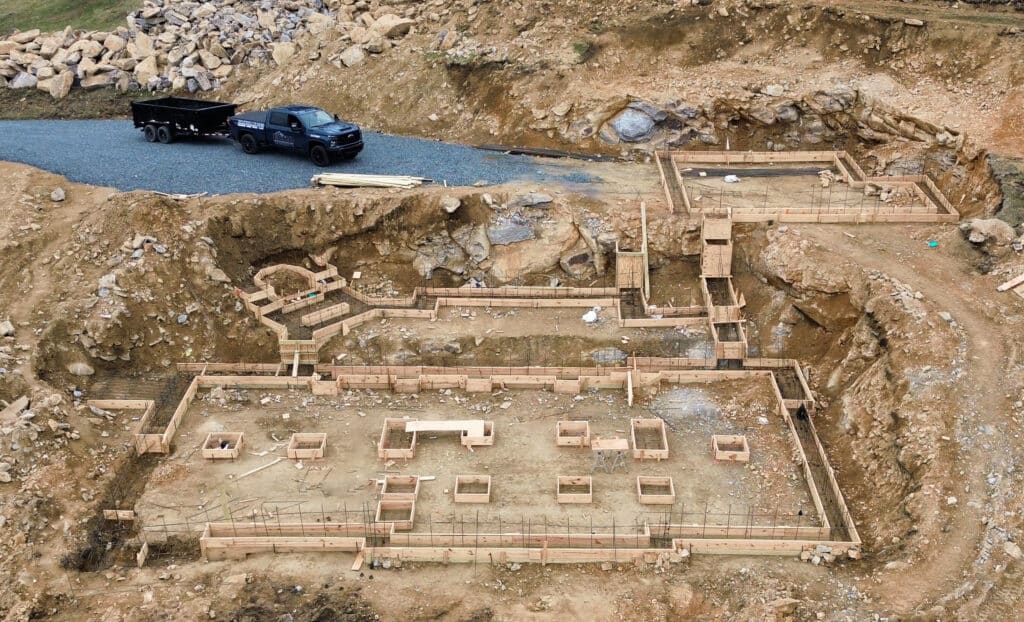
In the mountain counties of NC, TN, and VA, rock outcrops and shallow bedrock complicate site preparation for poured concrete foundations. Rock excavation is expensive and time-consuming, and if it’s encountered after mobilization without being anticipated in the bid, it becomes a significant change order. Walk the site before bidding and probe for shallow rock in any area with surface outcroppings.
Step 2: Excavation Standards for Poured Concrete Foundations
Excavation is the most physically demanding phase of site preparation for poured concrete foundations, and it’s where errors are most expensive to correct. OSHA excavation requirements govern trench safety, slope requirements, and soil classification for shoring — these aren’t optional and must be built into your site preparation for poured concrete foundations plan before the excavator mobilizes.
Excavation dimensions for site preparation for poured concrete foundations must accommodate the footing width, the foundation wall form width (typically 8–12 inches), plus working clearance for form crews — typically 18–24 inches of clear space outside the footing edge. Cutting the excavation too tight for site preparation for poured concrete foundations is a common time-wasting mistake that forces form crews to work in unsafe conditions or requires additional excavation after mobilization.
Bottom of excavation must be cut to a consistent elevation per the design drawings. Variation in bearing depth across the footing plane creates uneven bearing conditions that can produce differential settlement. For site preparation for poured concrete foundations, the bearing surface should be undisturbed native soil or properly compacted engineered fill — never loose backfill or organic material.
Step 3: Drainage Planning and Grading
Drainage planning is the most chronically under-invested phase of site preparation for poured concrete foundations in residential construction. A poured concrete foundation wall with a flawless pour and excellent waterproofing will still develop water problems if the site wasn’t graded to direct surface water away from the structure and if the perimeter drainage wasn’t designed to handle the hydrostatic load.
Site grading for poured concrete foundations requires positive drainage away from the foundation perimeter — the IRC specifies a minimum 6-inch drop in the first 10 feet of grade from the foundation wall. In low-lying areas, clay-heavy soils, or sites with limited natural drainage relief, this may require cut-and-fill grading work that needs to be included in the site preparation for poured concrete foundations scope and budget.
Perimeter footing drain design should be completed as part of site preparation for poured concrete foundations — before excavation begins, not as an afterthought after the pour. Footing drain sizing, routing to daylight or sump, and filter fabric specification are governed by IRC drainage requirements and should be confirmed with your foundation contractor before the excavator mobilizes.
Step 4: Utilities and Underground Infrastructure
Underground utility identification and marking is a legal requirement and a practical necessity in site preparation for poured concrete foundations. Call 811 (NC811, TN811) before any excavation to locate buried utilities — gas, water, electric, sewer, and telecommunications. Cutting an unmarked utility during site preparation for poured concrete foundations creates safety hazards, liability exposure, project delays, and repair costs that far exceed the time spent on proper pre-excavation utility marking.
For foundations with below-slab plumbing, the site preparation for poured concrete foundations phase includes rough plumbing coordination. Sewer lines, water supply penetrations, and floor drain locations need to be established and rough-set before the footing is poured — they can’t be added after the concrete is in place without saw-cutting, which is expensive and structurally compromising.
Step 5: Subgrade Preparation and Compaction
With excavation complete and utilities identified, the final step in site preparation for poured concrete foundations is subgrade preparation and compaction. The bearing surface for the footing must be compacted to a density that meets or exceeds the geotechnical requirements for the project’s soil classification. Loose, disturbed, or organic material must be removed and replaced with compacted granular fill or concrete mud mat before footings are poured.
Granular base installation — crushed stone or gravel — beneath the footing and slab area improves drainage, provides a stable working surface, and reduces capillary moisture migration. For crawlspace foundations, the vapor barrier installation sequence begins at this phase of site preparation for poured concrete foundations.
A pre-pour site inspection by your foundation contractor — verifying excavation dimensions, bearing elevation, subgrade compaction, and drainage routing — is the last checkpoint before footings are poured. This inspection catches site preparation for poured concrete foundations deficiencies before they’re buried under concrete.
Echo Concrete works with builders across NC, TN, SC, and VA to coordinate site preparation for poured concrete foundations from initial assessment through pre-pour inspection. Submit your blueprint at echowalls.com to start planning your foundation installation.