
Introduction
Concrete foundation building codes exist for a reason: they’re the minimum structural baseline that separates a foundation that performs from one that fails. But navigating concrete foundation building codes across multiple states is more complicated than it should be. While North Carolina, Tennessee, South Carolina, and Virginia all base their concrete foundation building codes on the International Residential Code (IRC) and International Building Code (IBC), each state adopts amendments on its own timeline, and local jurisdictions add another layer on top.
For builders operating across state lines in the Southeast, understanding how concrete foundation building codes differ by state and county is essential — not optional. A foundation that passes inspection in Buncombe County, NC, may need additional engineering review in Montgomery County, VA. A concrete specification that meets South Carolina foundation depth requirements may not satisfy East Tennessee mountain county requirements.
This guide covers the concrete foundation building code framework across all four states Echo Concrete serves, with a focus on the variables that matter most: frost depth, footing design, concrete strength requirements, rebar specifications, and waterproofing standards. For how these code requirements affect your foundation type choice, see our poured concrete vs. block foundations comparison. For how code requirements fit into your overall schedule, see our poured concrete foundation timeline guide.
The Code Framework: IRC, IBC, and State Amendments
Most residential construction across the Southeast falls under the International Residential Code (IRC). Commercial and mixed-use projects follow the International Building Code (IBC). Both are published on a three-year cycle by the International Code Council and adopted by states, sometimes with a lag of one to three cycles and with state-specific amendments that modify, add, or delete provisions.
The concrete foundation building codes that affect your projects most directly are found in IRC Chapter 4 (Foundations) and IBC Chapter 18 (Soils and Foundations). IRC Table R403.1 sets prescriptive footing widths and thicknesses by number of stories and foundation wall configuration. These tables are the starting point for most residential footing design — but structural engineer specifications, local AHJ (authority having jurisdiction) requirements, and geotechnical reports can all impose more stringent standards.
The most important thing to understand about concrete foundation building codes is that they specify minimums. Your structural engineer can — and often does — specify foundations that exceed code minimums based on site-specific soil conditions, building loads, or the engineer’s professional judgment. When code minimums and engineering specs diverge, the more stringent standard governs.
Frost Line Depth: The Primary Concrete Foundation Building Code Driver
Frost line depth — the maximum depth to which soil moisture is expected to freeze — is the primary driver of foundation depth in the concrete foundation building codes applicable across NC, TN, SC, and VA. Footings must extend below the frost line to prevent frost heave, which causes upward displacement of soil as water expands during freezing cycles.
North Carolina Foundation Code Requirements
Foundation code requirements in North Carolina are administered through the NC Department of Insurance Office of State Fire Marshal. The NC Building Code Council adopts and amends the IRC and IBC on a state schedule. Frost line depths vary significantly by region: western mountain counties (Buncombe, Henderson, Yancey, Madison) require footings at 15–18 inches minimum; Piedmont counties fall in the 12–15 inch range; and the coastal plain has minimal frost concerns. Always verify with the local AHJ — some western NC counties have adopted more conservative frost depth requirements than the state minimum.
Concrete strength requirements under North Carolina foundation building codes for residential construction in severe weathering regions: minimum 3,500 PSI with air entrainment. Footing reinforcement per the IRC prescriptive tables typically specifies two continuous #4 bars. Foundation walls must meet reinforcement requirements per IRC Table R404.1.2 for unbalanced fill height.
Tennessee Foundation Code Requirements
Tennessee concrete foundation building codes are administered through the Tennessee Department of Commerce and Insurance. East Tennessee — particularly the mountain counties at elevation — has frost depths of 12–18 inches. Middle Tennessee falls in the 10–12 inch range, and West Tennessee has minimal frost requirements. The Tennessee State Building Code adopts the IRC with Tennessee amendments; local jurisdictions in mountain counties may impose deeper footing requirements.
For builders working in east TN counties (Sevier, Blount, Monroe, Polk, Bradley), verify concrete foundation building code requirements with the county building official before finalizing footing design. Weathering probability in these areas is classified as severe, which drives the 3,500 PSI air-entrained concrete requirement for all below-grade foundation elements.
Virginia Foundation Code Requirements
Virginia concrete foundation building codes are enforced through the Virginia Uniform Statewide Building Code (USBC), which adopts the IRC and IBC with Virginia-specific amendments. Virginia has the most significant frost depth requirements in Echo Concrete’s service region. Northern Virginia can see frost depths of 24 inches or more. Southwest Virginia mountain counties — the area most relevant to our work — have frost line depths in the 18–24 inch range. Central Virginia falls in the 12–18 inch range, and coastal Virginia has minimal frost concerns.
Virginia foundation building codes also include specific provisions for radon mitigation in new construction in radon-prone counties. If your project is in a high-radon zone, foundation design must accommodate passive radon control systems — a concrete foundation building code requirement that affects sub-slab preparation and foundation wall penetration details.
South Carolina Foundation Code Requirements
South Carolina has the most moderate concrete foundation building code requirements in Echo Concrete’s service territory, reflecting its milder climate. The Upstate counties (Greenville, Spartanburg, Anderson, Cherokee) have frost depths in the 6–12 inch range. The Midlands and Low Country have minimal frost concerns. Minimum foundation depth under South Carolina building codes for residential construction is typically 12 inches below undisturbed ground surface regardless of frost considerations.
Concrete compressive strength requirements under South Carolina foundation building codes reflect the state’s moderate weathering classification in most areas — 3,000 PSI minimum, with 3,500 PSI required in areas classified as severe. The Upstate mountain-adjacent counties trend toward the severe weathering classification and its associated concrete foundation building code requirements.
Footing Size and Reinforcement Requirements
Beyond frost depth, concrete foundation building codes specify minimum footing widths and thicknesses based on building loads and soil bearing capacity. IRC Table R403.1 provides prescriptive footing dimensions for conventional light-frame construction. A typical single-story residential foundation on standard soil requires a footing at least 12 inches wide and 6 inches deep. Two-story construction and poor soil conditions require larger footings, and engineered drawings are required when conditions fall outside the prescriptive tables.
Rebar requirements for concrete foundation footings are specified in the IRC and in the structural drawings for engineered projects. The Portland Cement Association publishes comprehensive guidance on concrete foundation reinforcement that supplements the code minimums. Most residential footings require a minimum of two continuous horizontal bars (#4 or #5) running the full length of the footing, with vertical dowels tying the footing to the foundation wall. Cover requirements — the concrete distance between the rebar and the nearest face — must be maintained to protect reinforcement from moisture and carbonation.
Concrete Strength and Mix Requirements Under Foundation Building Codes
Concrete compressive strength requirements under concrete foundation building codes vary by exposure classification. The IRC classifies concrete exposure by weathering probability — negligible, moderate, or severe. Most of NC, TN, and VA mountain counties fall in the severe weathering category, which requires a minimum of 3,500 PSI with air entrainment. South Carolina and the lower Piedmont generally fall in moderate, which requires 3,000 PSI.
Air entrainment is a concrete foundation building code requirement for all concrete exposed to freeze-thaw conditions. Entrained air voids absorb the expansion pressure of freezing water within the concrete matrix, preventing internal fracture. Without air entrainment, concrete foundations in freeze-thaw environments experience progressive surface scaling and eventual structural degradation. This requirement applies to all foundation walls and footings in severe weathering zones — not just above-grade elements.
Echo Concrete specifies 4,000 PSI air-entrained concrete on all poured concrete foundation walls as a standard — above the code minimum, but consistent with best practice for long-term durability in the Southeast mountain zone climate.
Waterproofing Requirements Under Concrete Foundation Building Codes
Concrete foundation building codes distinguish between dampproofing and waterproofing for below-grade walls. Dampproofing — a single coating of bituminous material applied to the exterior wall face — is the minimum requirement for below-grade walls in contact with soil when the water table is below the footing. Waterproofing — a continuous membrane system — is required when the water table may be at or near the footing elevation, or when drainage conditions are not well-controlled.
In practice, most quality builders in the Southeast specify waterproofing rather than dampproofing even where code only requires dampproofing. The cost differential is modest; the long-term liability differential is significant. Poured concrete foundation walls accept waterproofing membranes more effectively than block walls because the smooth, monolithic wall surface provides consistent membrane adhesion without mortar joint bridging or void fill concerns.
Inspection Checkpoints Under Concrete Foundation Building Codes
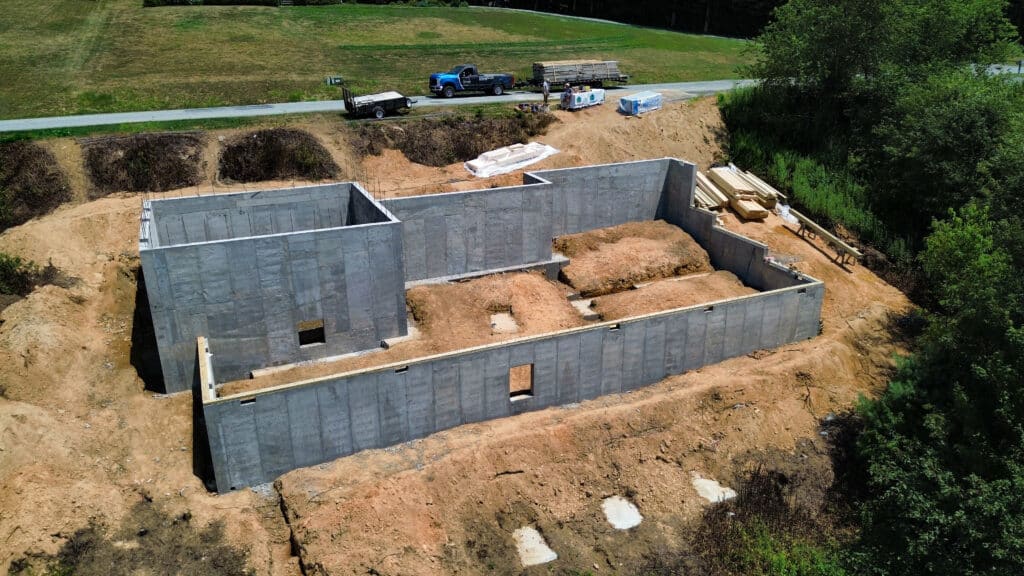
Concrete foundation building codes require inspection at specific milestones before subsequent work can proceed. Missed inspections can require remediation — including opening backfilled excavations — at significant cost and schedule impact. Standard concrete foundation building code inspection sequence:
- Footing excavation and form inspection (before footing pour)
- Rebar and reinforcement inspection (before footing or wall pour)
- Foundation wall form inspection (before wall pour)
- Foundation wall inspection after form strip (verifying wall placement and surface condition)
- Waterproofing and drainage inspection (before backfill)
Build each of these inspection windows into your poured concrete foundation timeline. Inspector availability varies by jurisdiction, and a 24–48 hour scheduling gap at any inspection point can compress or extend your project schedule significantly.
Echo Concrete works directly from your structural drawings and coordinates with local inspectors across our NC, TN, SC, and VA service region. Submit your blueprint at echowalls.com for a project-specific quote that accounts for local concrete foundation building code requirements.