
Poured Concrete vs. Block Foundations: A Construction Manager’s Complete Guide
Introduction
If you’ve spent any time managing residential or commercial builds in the Carolinas, Tennessee, or Virginia, the poured concrete vs. block foundations conversation is one you’ve had more than once. A client sees the foundation line item and questions why you can’t just use cinder block. A subcontractor defaults to block because that’s what his crew has always done. Somewhere in the middle, you’re the one who has to make the call — and that call carries real consequences for your schedule, your liability, and the structural performance of every building you put your name on.
The poured concrete vs. block foundations debate has been going on for decades. But the answer has gotten clearer as poured wall technology has improved and the Southeast construction market has tightened margins to the point where foundation decisions materially affect project profitability. This guide breaks down the poured concrete vs. block foundations comparison the way a builder needs it — not as a homeowner primer, but as a practical decision framework covering structural performance, schedule impact, waterproofing, cost, and long-term risk.
At Echo Concrete, poured concrete vs. block foundations is a question we answer every week. We install poured concrete foundation walls across NC, TN, SC, and VA, and we’ve seen how the choice plays out across hundreds of projects. Here’s what that experience tells us — including why the timeline difference alone often settles the poured concrete vs. block foundations question before the structural argument even begins.
What Each Foundation Type Actually Involves
Poured Concrete Foundation Walls
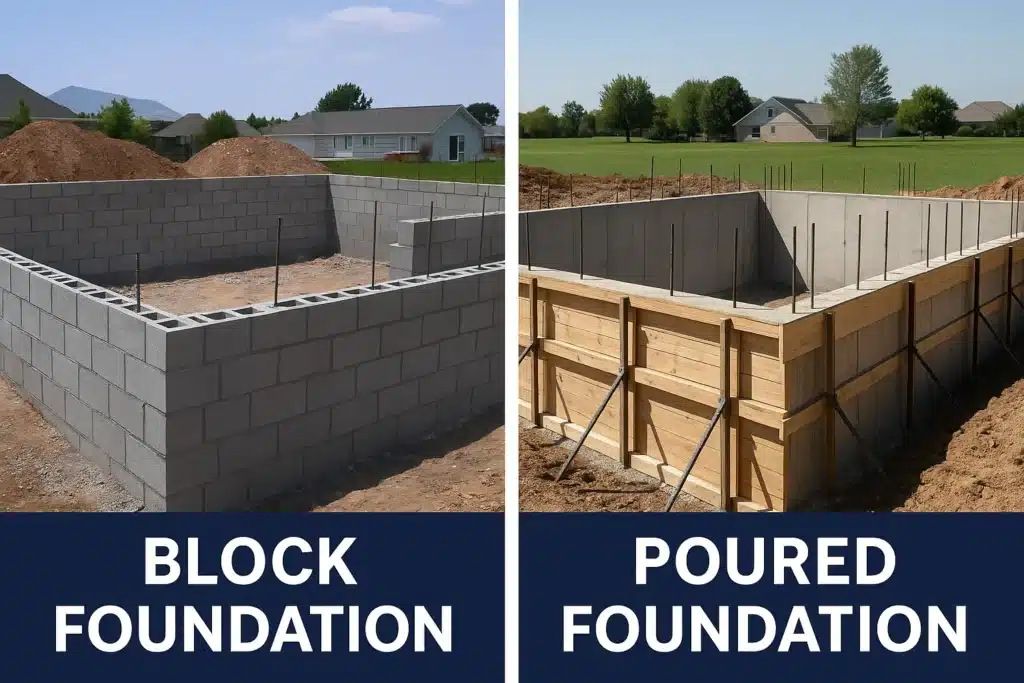
A poured concrete foundation starts with steel-reinforced wooden or aluminum forms set directly on cured footings. Once the forms are plumb, braced, and tied to spec, concrete — typically a 3,500 to 5,000 PSI mix — is pumped in and vibrated to eliminate air voids. Forms strip in 24 to 48 hours. The result is a monolithic, seamless poured concrete foundation wall with no mortar joints, no block voids, and continuous lateral and compressive strength throughout the entire structure.
Poured concrete foundation walls are equipment-intensive, but that’s exactly what makes them fast and consistent. A well-coordinated crew can form, pour, and strip a standard residential poured concrete foundation in two to three days. That speed is one of the most underappreciated factors in the poured concrete vs. block foundations comparison — particularly when you’re running multiple starts and need your framing crew to have a clear runway.
Concrete Block (CMU) Foundations
Concrete masonry unit (CMU) foundations — block or cinder block foundations — are built by stacking pre-formed concrete blocks bonded with mortar, with steel rebar running vertically through the cores, which are then grouted solid. Block construction requires fewer heavy equipment inputs, which can be useful on access-limited sites. But in the poured concrete vs. block foundations comparison, block is significantly more labor-intensive, more mason-skill-dependent, and considerably slower than a poured concrete foundation wall of comparable size.
That variability is the core problem with block in a production environment. An uneven mortar joint isn’t just cosmetic — it’s a water infiltration point and a structural weakness in the lateral load path. When you’re managing volume, block introduces inconsistency that poured concrete walls eliminate by design.
Poured Concrete vs. Block Foundations: The Full Comparison
Lateral Strength — Poured Concrete Wins Decisively
This is the clearest technical advantage in the poured concrete vs. block foundations debate. Poured concrete foundation walls are monolithic — no mortar joints means no failure planes for soil pressure, hydrostatic pressure, or freeze-thaw movement to exploit. Research from the Portland Cement Association confirms that poured concrete walls deliver superior lateral load resistance compared to CMU walls of equivalent thickness, particularly under sustained soil and water pressure.
Block walls without fully grouted cores and properly placed continuous rebar can bow under lateral pressure — especially on deep excavations or in areas with expansive clay soils, which describes much of the Piedmont and the mountain zones of western NC, east TN, and southwest VA. In the poured concrete vs. block foundations comparison on any job with significant backfill depth, poured concrete walls are the structurally defensible choice and the one that minimizes long-term warranty exposure.
In the poured concrete vs. block foundations comparison, lateral strength is non-negotiable for deep basements, hillside lots, or any application where sustained soil pressure is a design factor. Poured concrete wins this category outright — and the margin is not close.
Water Resistance — No Joints, No Failure Points
Poured concrete foundation walls are monolithic — no mortar joints means no built-in pathways for water infiltration. The wall surface is denser and smoother than stacked block, and waterproofing membranes adhere more consistently to it. In the Southeast, where summer rainfall events and fluctuating water tables are routine, that performance difference matters.
Block walls — even well-built ones — have mortar joints at every course. Hydrostatic pressure will find the weakest joint over time. That’s why block foundations in wet conditions develop efflorescence, staining, and water intrusion at joint lines years after construction. In a finished basement or conditioned crawlspace, that’s an unacceptable outcome. In the poured concrete vs. block foundations comparison, water resistance is another category where poured walls carry meaningfully lower long-term risk.
Installation Speed — A Real Schedule Advantage
From a scheduling standpoint, the poured concrete vs. block foundations comparison isn’t close. Once footings are cured, a poured concrete foundation wall can be formed, poured, and stripped in one to three days. The process is machinery-driven and doesn’t depend on masons working course by course at a pace limited by mortar cure time.
Block foundations require each course to be individually set and allowed to develop sufficient bond strength before subsequent lifts. For a builder managing multiple trades on a tight timeline, faster poured concrete foundation walls compress the overall schedule — reducing weather exposure windows, getting framing crews on site earlier, and protecting delivery dates. Across a volume operation, recovering two to four days per foundation start compounds into a significant competitive advantage.
Poured concrete vs. block foundations isn’t just a structural question — it’s a schedule question. The installation speed of poured walls is one of the primary reasons production builders in the Southeast have shifted decisively toward poured concrete.
Quality Consistency — Controlled Process vs. Crew Variability
Poured concrete foundation wall quality depends on mix design, pour process, and vibration — all controllable, verifiable, and independent of individual worker skill on the day of the pour. Block wall quality depends on mason skill, mortar consistency, joint thickness, and proper core fill — variables that change based on crew experience and site conditions.
In the poured concrete vs. block foundations comparison, quality consistency is the factor that volume builders feel most acutely over time. On a poured foundation, what you see when the forms strip is the wall you get. On a block foundation, quality variance is baked into the process. Problems often don’t surface until moisture or soil movement reveals them — months or years later.
Cost — Total Installed Cost Is the Right Metric
The poured concrete vs. block foundations cost comparison is more nuanced than material price per unit. Block materials cost less than ready-mix concrete per cubic foot. But when you factor in mason labor hours, extended schedule time, equipment requirements, and downstream structural warranty risk, poured concrete walls are often cost-competitive with block — and sometimes less expensive on a total-project basis.
According to NAHB data on new residential construction, poured concrete foundations are increasingly the default choice for production builders in markets across the Southeast, precisely because the total-cost calculus favors them. The real question in the poured concrete vs. block foundations cost comparison isn’t the material line item — it’s total installed cost, including labor efficiency, schedule value, and long-term performance risk.
Code Requirements: Poured Concrete vs. Block Foundations in NC, TN, SC, and VA
Both poured concrete and block foundations must satisfy the same structural code minimums — but the path to compliance differs. IRC Table R403.1 outlines footing sizing requirements based on load and soil bearing capacity. The IRC also specifies minimum concrete compressive strength, rebar placement, and waterproofing standards. In the poured concrete vs. block foundations context, poured concrete walls consistently meet these requirements through a more straightforward and verifiable construction process.
For a full regional breakdown of foundation code requirements across NC, TN, SC, and VA — including frost line depths by county, rebar specifications, concrete PSI minimums, and waterproofing standards — see our complete guide to foundation building codes in the Southeast. Getting the code requirements right before you break ground is the fastest way to avoid inspection holds and change-order exposure on your foundation phase.
When Block Foundations Still Make Sense
An honest poured concrete vs. block foundations comparison has to acknowledge that block isn’t always the wrong answer. There are specific circumstances where CMU construction is the better call:
Remote or access-limited sites where a concrete pump truck cannot mobilize economically
Repairs or additions to existing block foundations where matching the current system is the right approach
Highly irregular foundation geometries that panel forms cannot efficiently replicate
Jurisdictions with entrenched CMU code precedent where inspector familiarity strongly favors block
Outside of these specific scenarios, the poured concrete vs. block foundations comparison strongly favors poured concrete walls for new residential and light commercial construction across the Southeast — on every dimension that matters to a builder running projects at volume.
Making the Right Call on Poured Concrete vs. Block Foundations
If you’re managing residential builds, multifamily projects, or light commercial construction in North Carolina, Tennessee, South Carolina, or Virginia, the poured concrete vs. block foundations decision deserves a deliberate answer early in project planning — not a default based on habit or subcontractor preference. It affects your mobilization sequence, your schedule buffer, your structural warranty exposure, and the long-term performance of every building your name is on.
The poured concrete vs. block foundations case for poured walls rests on four clear advantages: superior lateral strength, better water resistance, significantly faster installation, and more consistent quality. In a production construction environment, those advantages compound. The builder who gets their foundation in three days instead of six, with no mortar joints and a smooth surface ready for waterproofing, is the one whose framing crew is already up on the second floor while the competition is still waiting on block delivery.
The poured concrete vs. block foundations debate has a practical answer for most Southeast builders: poured concrete walls deliver better structural performance, faster schedules, and lower long-term risk. The only question is finding a foundation contractor who can execute consistently across your entire project pipeline.
Echo Concrete installs poured concrete foundation walls across NC, TN, SC, and VA. We work directly from your blueprints, coordinate with your excavation contractor, and move fast so your framing crew has a foundation ready to go. Submit your blueprint at echowalls.com for a project-specific quote on your next poured concrete foundation.